

AI in Healthcare: Moving Past the Hype
The promise of AI in healthcare is real — but so is the noise. Payers and health plans are under pressure to adopt AI quickly, often without a clear framework for what’s worth building, buying, or waiting on. At Elligint Health, we’ve spent the past year developing a deliberate approach grounded in data readiness, human oversight, and honest assessment of what AI can actually deliver today. That work is now public: we’ve formally published our AI Position Statement, and it reflects a clear point of view: AI is augmented intelligence, designed to serve people, not the other way around.
The statement centers on six principles that define how we build, deploy, and govern AI across our platform and operations:
- Humans always stay in the loop – every high-impact AI output is reviewed by a person before it acts in the world
- Data is sacred – PHI is never used in external training pipelines; all access is audited
- Bias has no place here – we actively monitor and test AI outputs for errors, drift, and equity impacts
- Transparency is non-negotiable – clients and members will always know what is human and what is machine
- Governance is a prerequisite – our AI Governance Committee reviews every new use case before it goes live
- We hold both the spirit and the letter – policy without conviction is just paperwork
That last point matters more than it might seem. Governance is the foundation, not an afterthought. UM workflows require human approval at every decision point, and the platform is designed to prevent automated denials, consistent with CMS and NCQA standards. Our goal isn’t to move fast and figure it out later. It’s to build trust before expanding what AI does because in healthcare, that trust is the product.
Hub 2: Built for the Way Integration Should Work

Standardized, cloud-based, and designed to scale
Last month, we introduced Hub 2 — the next evolution of Helios Hub®, Elligint Health’s purpose-built integration engine. Hub 2 standardizes the integration process, eliminating much of the custom-coding that integrating data into Helios once required and supporting a broad range of data exchange methods and standards right out of the box:
- Data exchange methods: RESTful APIs, FHIR R4, SFTP, EDI, and HL7
- System connectivity: Core administration, eligibility, clinical criteria, pharmacy, and delegated vendor systems
- Data flows: Both real-time and batch supported
- Visibility: Automated acknowledgment files confirm successful or failed record processing — no manual follow-up required
- Interoperability: Aligned with CMS FHIR-based data exchange standards shaping the regulatory landscape for health plans
The result is faster integration, greater consistency, and a foundation built to scale, without the custom development work that once made adding new data flows a lengthy process.
Client Services Update
A partnership model built around you
At Elligint Health, we’re continuing to invest in a client experience designed to be proactive, transparent, and aligned with your goals. Our Client Experience organization has formalized processes around client reviews and proactive account health assessments designed to provide a complete, real-time view of your account. Implementations follow a standardized delivery model with clear milestones and defined ownership, giving clients visibility from kickoff through go-live and rather than measuring success by ticket volume, we’ve aligned our focus around client satisfaction and quality at every touchpoint.
Supporting that commitment are tools and resources designed to help reduce your team’s time-to-value and support long-term success with Helios®.
- The Helios Learning Management System (LMS) is now rolling out across the platform, providing interactive, self-paced training accessible directly from the Help menu.
- A growing library of courses, narrated tutorials, downloadable reference materials, and on-demand recordings helps users build skills and confidence in their day-to-day work
- New configuration courses, workflow-focused training content, and system tutorials, including training on configuring and testing rules and automations, are being added throughout the year to support both new users and experienced teams.
- A Helios Certification Program featuring individual and organization-level credentials is on the horizon to help organizations validate knowledge and promote adoption across teams.
Finally, your feedback directly shapes our direction. We’ve formalized multiple channels for collecting client perspectives so that we can continue to improve our services. Our commitment: every feedback loop closes, and you’ll see your input reflected in service priorities and in every interaction that follows.
Closing the Visibility Gap in Care and Utilization Management
Real-time performance dashboards are changing how health plans manage performance — from the front line to the executive suite
Health plans and managed care organizations invest significant resources in CM and UM programs — but measuring how those programs actually perform in real time remains a persistent challenge. The data generated by daily workflows often ends up in reports that are days old, manually compiled, or siloed, leaving supervisors and program leaders without the visibility they need to act. The operational cost is real:
- Missed intervention windows — task queues falling behind or members disengaging may not surface until outcomes are already affected
- Compliance exposure — authorizations aging toward regulatory deadlines require near-real-time queue visibility to manage proactively
- Leadership operating on stale data — decisions and coaching conversations built on weekly or monthly reports miss what’s happening now
Together, they strengthen our ability to deliver both meaningful product innovation and an exceptional client experience as we continue to grow the Helios® platform.
This is the problem that embedded, near-real-time performance dashboards are designed to close. Rather than requiring staff to export data or wait for a reporting cycle, the right analytics layer surfaces performance continuously — connecting workflow activity already happening in the platform to the operational intelligence that managers and executives need to make decisions. The most effective implementations bring together multiple performance dimensions in one place, with interactive filtering that lets users move from a program-level view down to individual staff performance or member-level detail without switching tools.
What Helios Performance Dashboards Deliver
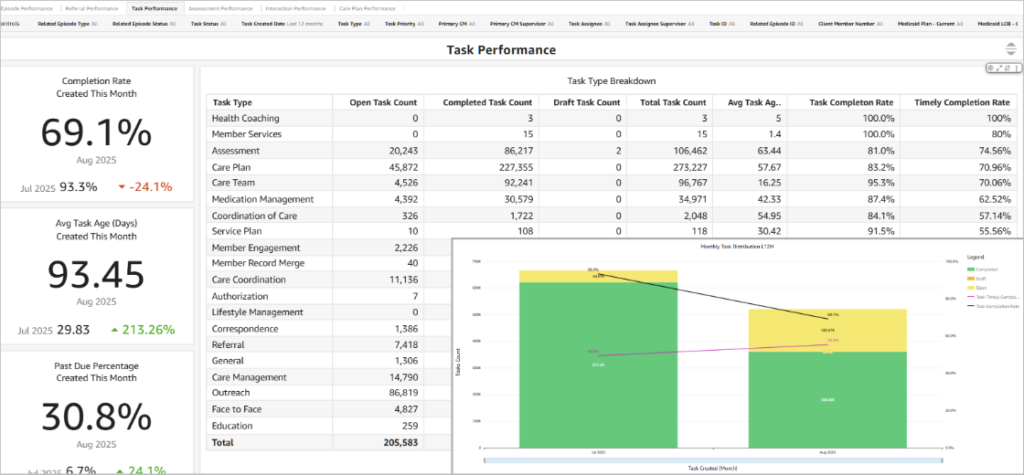
For Helios® clients, this kind of visibility is available today. Helios CM Performance Dashboards give care management teams near-real-time insight across six dimensions of program performance:
- Episode Performance — how members are moving through the care journey, where bottlenecks exist, and whether engagement and completion rates are on track
- Referral, Task, and Interaction Performance — workload balance, outreach effectiveness, and care coordination activity across teams
- Assessment and Care Plan Performance — timely completion, quality indicators, and aggregated visibility into member-centered care plan progress
Example Task Completion Dashboards
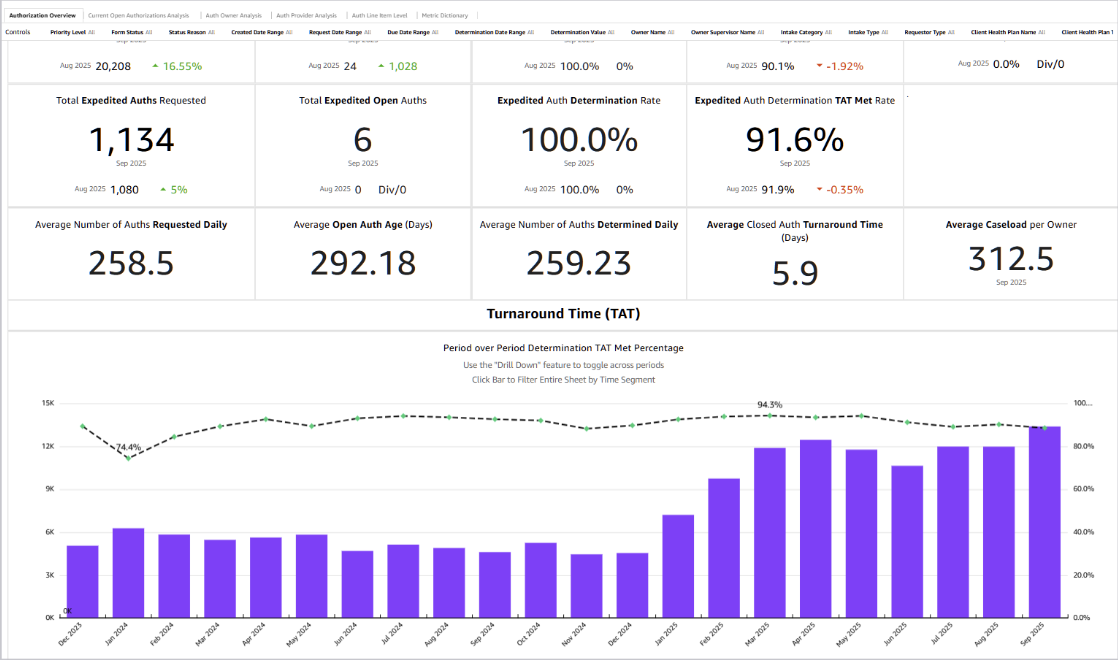
For clients using Helios’ UM module, our UM Authorization Performance Dashboards extend that visibility across the full authorization lifecycle — from intake through determination and notification — with focused views into open queue health, staff performance, turnaround time compliance, and provider-level trends.
Example Authorization and Turnaround Time Dashboards
If your team hasn’t yet had a walkthrough of either set of dashboards and would like one, please reach out to your Client Success Manager to get scheduled.
Elligint Health Team Spotlight
Meet Sue Powers, Elligint Health’s Chief Growth Officer
A rare combination of technical depth, sales expertise, and mission-driven focus is fueling Elligint Health’s growth
Sue Powers didn’t follow a traditional path to sales leadership. She started her career as a programmer with a math and computer science degree, and that technical foundation has never left her. When a mentor finally convinced her to make the move into sales in the mid-90s, she brought something most salespeople don’t have: the ability to look under the hood. Since joining what was then Virtual Health in 2016, she has built a growth practice rooted in deep product knowledge, honest client relationships, and a simple but powerful philosophy she calls “do good by doing good.” Today, as Elligint Health’s Chief Growth Officer, she’s focused on one thing: making a genuine difference for the health plans the company serves.

Sue is quick to challenge the conventional picture of what sales looks like. For her, winning new business is less about pitching a product and more about understanding the specific pressures each client faces — and right now, those pressures are significant. Health plans are navigating a challenging landscape, and the conversations she’s having in the market every day reflect that:
- Financial pressure: Plans are losing money and looking for ways to do more with less, making efficiency and workforce productivity top priorities.
- Workforce challenges: Aging workforces and budget constraints are pushing plans to find technology solutions that extend the capacity of their teams.
- Regulatory mandates: Requirements like the CMS-0057-F are driving urgent platform decisions
- Artificial intelligence (AI): Plans want to understand how AI can meaningfully move the needle on administration, utilization management, and clinical outcomes
Underlying all of it is something Sue has learned over decades in the industry: the best product doesn’t always win. Trust does. “At the end of the day, they are trusting that these people will be able to handle my business,” she says. That belief shapes everything about how she approaches a sales cycle — building relationships across an organization, never over-promising, and making sure the team behind her can deliver on every commitment she makes. “What I really want to do,” she says, “is make a difference through Elligint Health and through Helios for our clients. If we focus on helping our clients succeed, we will succeed.”
June 3rd Client Webinar Recap
Clients got a look at what’s new and what’s next
Elligint Health’s inaugural client webinar this month brought together the full senior leadership team — including CEO Chris Caramanico, Chief Growth Officer Sue Powers, Head of Product Amy Qureshi, and new Chief Client Experience Officer Joe Bodley — for a candid conversation about where the company is headed and what that means for clients.
Platform Updates and What’s Ahead
Amy Qureshi led the product update, highlighting recent deliveries and the road ahead. Recent releases include:
- Streamlined UM navigation
- Enhanced operational dashboards for both utilization and case management
- A new, self-paced LMS with on-demand training pathways
- Helios Hub upgrade to speed platform integrations
Looking ahead, the product focus is on expanding automation, unifying clinical and operational data, and enhancing care collaboration.
A New Standard for Client Experience
Joe Bodley outlined a client experience vision built on proactive partnership: account managers who function as strategic partners, anticipating needs and bringing insights to every conversation. Feedback will flow through formalized channels, with named owners and deadlines ensuring every action item reaches resolution.
On AI: Transparent and Governed 
Chris closed with Elligint Health’s position on AI: measured, transparent, and client-first. The company’s AI governance framework — a subset of which is available on the company website — covers internal use, partner vetting, and product-embedded features. All AI capabilities will be optional and configurable, with humans kept in the loop. The goal is to reduce administrative burden and surface insights, enabling care teams to focus on high-value work.
Clients who were unable to join are encouraged to reach out to their account manager with questions — and to watch for more opportunities to engage as Elligint Health continues to grow in partnership with its client community.
If you missed our webinar and would like to watch on demand, please feel free to contact your account manager.